
You have no items in your shopping cart.
Diagnosing the Problem: The Role of a Ground Stability Survey
Before rolling out heavy machinery or installing permanent structures, it is critically important to understand the specific geological profile of the site. A formal ground stability survey systematically maps underlying soil structures, identifies potential voids, and measures the load-bearing capacity of the immediate area. In most instances, proceeding without this diagnostic step leaves operations vulnerable to unpredictable shifts and severe structural sinkages.
This survey process usually reveals hidden vulnerabilities such as excessive moisture retention, weak subgrades, or the early stages of natural ground subsidence. Armed with robust environmental data, project managers can deploy targeted reinforcement strategies rather than relying on reactive, temporary fixes like constant grading or excessive gravel dumping.
The Mechanics of Natural Ground Subsidence
Natural ground subsidence occurs when the earth's surface progressively sinks or collapses, often caused by changes in groundwater levels, soil compaction, or the dissolution of underground minerals. In remote or highly weathered locations, this subsidence drastically alters the topography, creating uneven and highly dangerous working environments. It is a slow, deceptive process. While superficial cracks or minor pooling might seem manageable initially, they frequently precede major surface failures.
Addressing natural ground subsidence requires more than just filling in craters with loose aggregate. Effective mitigation demands structural components that distribute heavy loads evenly across the surface, preventing localised pressure points that accelerate soil collapse.
Common Misunderstandings About Surface Reinforcement
Site managers frequently assume that pouring thick asphalt or compacting heavy layers of crushed rock is the ultimate solution for poor ground. However, rigid surfaces like concrete and bitumen are highly susceptible to cracking under the pressures of natural ground subsidence or extreme thermal expansion. Once cracked, water infiltrates the subgrade, further undermining the foundation.
Similarly, loose gravel is notoriously difficult to maintain. Heavy vehicles push the gravel aside or bury it in the soft earth, resulting in persistent mud generation and immediate rutting. The more effective approach involves using cellular or permeable grids that lock fill material in place, maintaining a stable, unified surface without compromising natural drainage.
Choosing the Right Ground Stabilisation Solution
Once a site investigation confirms weak subgrades, reactive clay, or traffic-related surface failure, the next step is selecting a stabilisation approach that matches how the area will actually be used. There is no single solution that suits every site; the right choice depends on load requirements, drainage needs, subgrade conditions, and whether the surface is temporary or permanent.
The most common approaches each come with genuine trade-offs.
Loose aggregate is low-cost and quick to lay, but it shifts under repeated traffic, washes out in wet weather, and demands constant maintenance. It suits temporary or very low-traffic areas, but rarely holds up as a long-term solution on active sites.
Asphalt and concrete deliver a smooth, high-capacity surface, but both are rigid. On sites with unstable or reactive subgrades, that rigidity becomes a liability, cracks propagate quickly, water ingress accelerates failure, and repairs are expensive and disruptive. They perform well where the subgrade is genuinely stable and the surface is permanent.
Geotextile membranes address a different part of the problem. Laid beneath aggregate or pavement layers, they separate the subbase from the subgrade, prevent fines migration, and extend the life of the surface above. They are an important part of most stabilisation systems, but are rarely sufficient on their own.
Modular interlocking pavement systems occupy a different category entirely. Rather than sitting rigidly on top of the ground, they work with it, distributing load across a wider area, accommodating minor ground movement without cracking, and allowing water to drain through the surface rather than pond on top. This makes them particularly well-suited to sites where ground conditions are variable, traffic is repeated, or surface failure carries real safety and productivity consequences.
Form Direct's Trex Ground Stabilisation System offers two variants designed for different ends of the load spectrum.
TrexPave is engineered for residential, commercial, and light civil applications, car parks, driveways, access ways, and landscaped traffic areas where finish, stability, and drainage all matter. Installed over a prepared subbase and filled with approved materials, it locks aggregate in place and prevents the rutting and washout that loose gravel cannot resist.
TrexLok is built for heavier-duty conditions, construction sites, mining hardstands, and industrial environments where traffic is constant, loads are significant, and surface failure quickly becomes a safety and operational problem. Its interlocking design spreads load more evenly across the subbase, reducing the stress concentration that causes rigid pavements to crack under the same conditions.
The table below summarises how these options compare across the criteria that matter most on site:
| Stabilisation Method | Primary Advantage | Typical Drawbacks | Best Application |
|---|---|---|---|
Loose Gravel or Aggregate |
Low upfront cost and simple installation |
Shifts under traffic, washes out, and needs constant maintenance |
Temporary, low-traffic areas |
Asphalt or Concrete |
Smooth, high-capacity finished surface |
Cracks over unstable ground, traps water, expensive to repair |
Permanent urban pavements with stable subgrades |
Geotextile Membrane |
Prevents fines migration and extends pavement life |
Must be combined with other surface treatments |
Subbase separation layer on most stabilised surfaces |
TrexPave |
Stable, permeable surface with a cleaner finish |
Requires correct subbase preparation |
Car parks, driveways, walkways, and light civil access areas |
TrexLok |
Built for heavier loads and harsher operating conditions |
Requires proper design for heavy-duty use |
Mining, industrial hardstands, construction access, and heavy-duty traffic zones |
Real-World Applications: Securing Critical Infrastructure
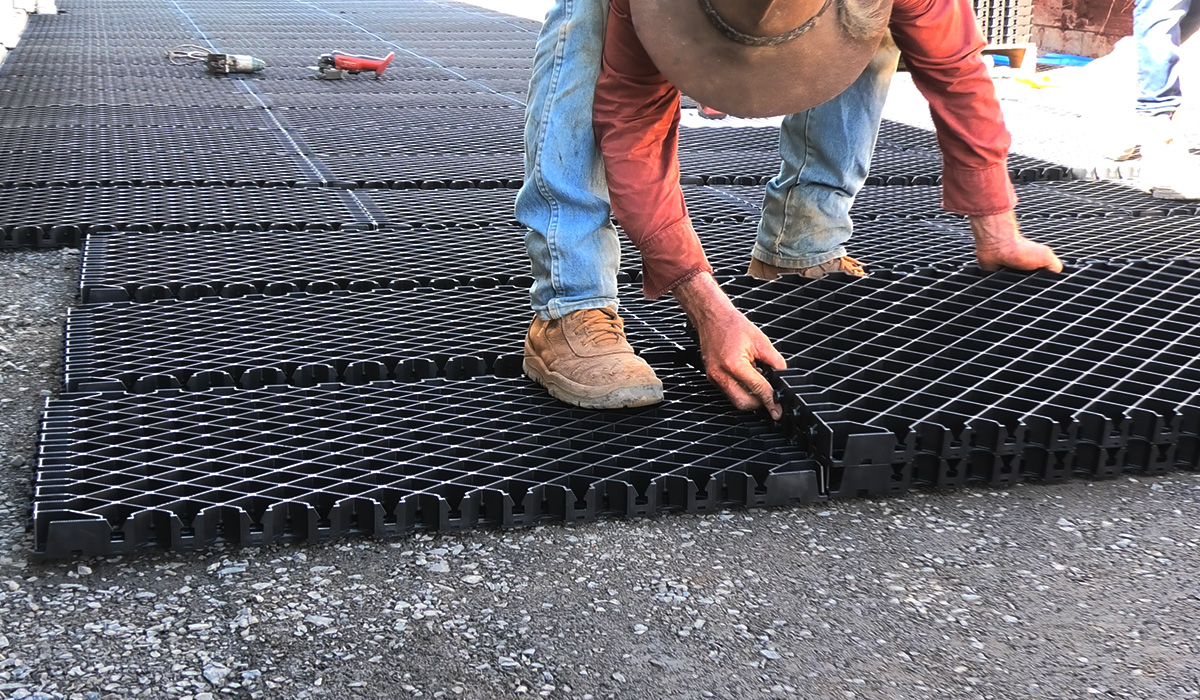
Stabilised ground surfaces support heavy equipment operations without rutting or surface failure.
On sites with poor subgrades or repeated heavy traffic, the value of the right system shows up quickly in reduced maintenance, safer access, and more reliable performance.
For example, on a storage shed slab project, site managers needed to create a stable working surface over vulnerable ground so equipment could continue moving without rutting the area or disturbing the base. By using an interlocking ground stabilisation system to contain the fill and spread load more evenly, they reduced lateral movement and helped keep the surface serviceable through wet conditions.
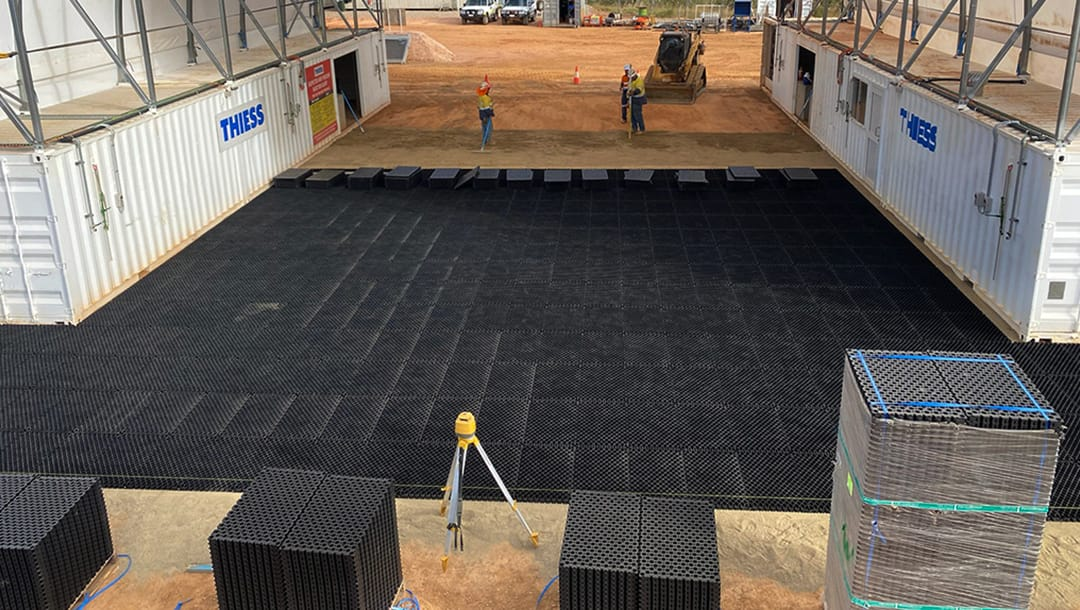
Interlocking grid systems lock fill material in place, preventing lateral movement and maintaining surface integrity under load.
A mine workshop slab project showed the same principle under much heavier operational pressure. In that environment, maintaining traction and surface consistency is critical for both safety and productivity. The stabilised surface reduced the need for repeated repairs and provided a more dependable working platform in a high-intensity site setting.
Achieving Long-Term Stability
Securing challenging terrain is an ongoing commitment to safety and operational efficiency. By investing in comprehensive diagnostics and implementing modern load-distributing structures, businesses effectively neutralise the threats posed by unstable soils and seasonal erosion.
For projects that need a more reliable alternative to loose aggregate or failing hardstands, explore the Trex Ground Stabilisation System. With TrexPave for lighter-duty applications and TrexLok for heavy-duty environments, it offers a practical way to improve drainage, stabilise the surface, and reduce ongoing maintenance across demanding sites.

