
You have no items in your shopping cart.
The Impact of Poor Drainage
When construction site flooding occurs, the consequences ripple through every aspect of the project. Common causes include inadequate site grading, blocked temporary drains and a reliance on undersized or outdated pipes that buckle under pressure.
The consequences of poor drainage planning include:
- Costly Delays: Work halts entirely while the site is pumped and dried.
- Material Destruction: Stored materials like timber, cement and plasterboard are ruined upon contact with water, destroying your project budget.
- Structural Weakness: Prolonged water exposure can compromise the foundations and scaffolding stability.
- Safety Hazards: Muddy terrain and hidden debris create severe slip and trip risks for workers on site.
The Solution: Designing for High-Capacity, Fail-Safe Drainage
An effective drainage system must do more than just meet basic compliance. It needs to handle sudden high-volume flows, survive the movement of heavy machinery, and be installed rapidly before the weather turns.
To achieve this, forward-thinking site engineers and civil contractors are moving away from traditional materials like concrete and PVC, favouring High-Density Polyethylene (HDPE) stormwater pipes.
Why HDPE Outperforms Traditional Materials
Concrete is exceptionally heavy and difficult to install. PVC, while lighter, can be brittle and susceptible to UV degradation when exposed. HDPE stormwater pipes provide a high-performance alternative backed by hard data:
- Capacity: Due to a lower friction coefficient (Manning’s n ≈ 0.009 – 0.012), HDPE pipes can carry up to 30% greater flow volume than concrete pipes of the same diameter and slope.
- Weight: At just 12.0 kg/m (for 450mm diameter), HDPE is 15x lighter than the equivalent concrete pipe (~180 kg/m), drastically reducing heavy machinery requirements.
- Lifespan: Industry-rated for 100+ years, immune to chemical and acidic soil corrosion.
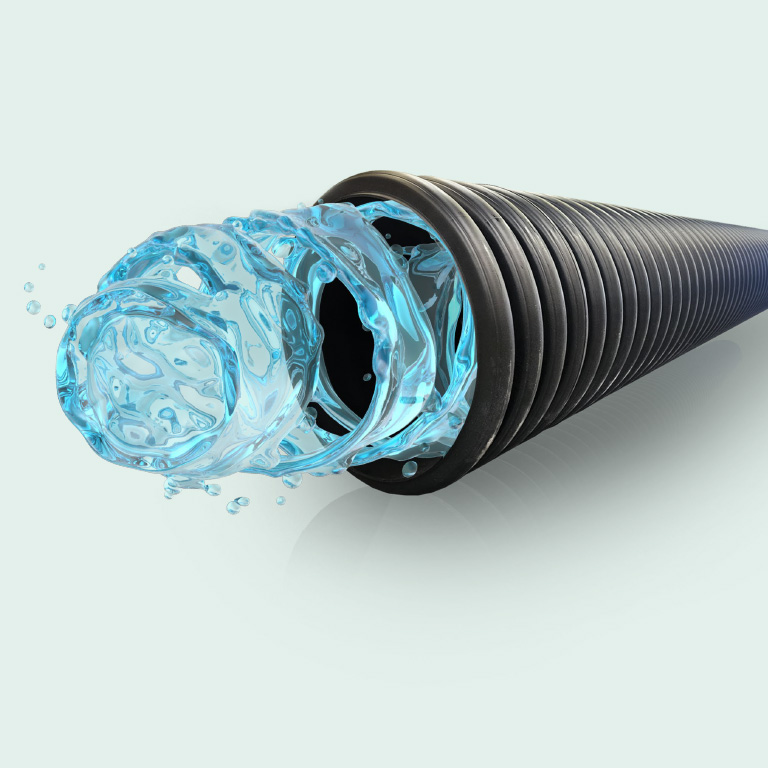
HDPE stormwater pipes offer higher flow capacity, faster installation and longer service life than concrete or PVC alternatives.
Material Comparison: Concrete vs PVC vs HDPE
To understand the operational and financial impact of switching materials, it’s essential to look at how they stack up across key construction criteria:
| Feature | Concrete (RCP) | PVC | HDPE |
|---|---|---|---|
Weight / Handling |
Extremely heavy (requires cranes) |
Lightweight |
Ultra-lightweight (up to 20x lighter than concrete) |
Flexibility |
Rigid, vulnerable to cracking |
Moderate, can become brittle |
Highly flexible (withstands ground movement & heavy loads) |
Installation Speed |
Slow (short 2.4m lengths = more joints) |
Fast |
Very fast (supplied in 6m lengths, 60% fewer joints) |
Chemical Resistance |
Low (susceptible to acidic soils) |
Good |
Excellent (immune to corrosion and site runoff) |
Lifespan |
~50+ years |
~50+ years |
100+ years |
Flow Efficiency |
Standard (n ≈ 0.013) |
High |
Highest (carries up to 30% more volume than concrete) |
Material choice directly affects installation speed, flow capacity and long-term resilience in stormwater systems.

