
You have no items in your shopping cart.
Eco-Friendly Solutions for Sediment Control
The EnviroBlanket Coir Geotextile Mesh, commonly known as coconut fibre mesh, is made from coconut husk fibres tightly woven into biodegradable sheets. It stabilises soil, prevents erosion and supports plant establishment across a wide range of environmental conditions.
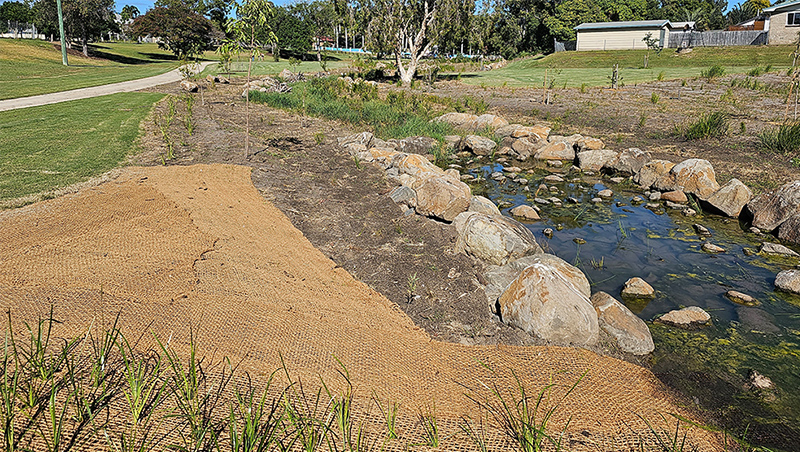
700gsm EnviroBlanket product used in Walshpool Creek Park.
Erosion Prevention
Coir geotextile mesh is particularly effective in erosion-prone areas such as slopes, riverbanks and shallow channels. It acts as a protective layer that absorbs water impact, holds soil in place and prevents sediment from washing into nearby waterways.
Capturing Runoff Sediment Naturally
Coir mesh functions as a natural filter. As water flows through, the fibres trap fine sediment particles, reducing turbidity and helping restore water quality downstream. This makes it an ideal alternative to synthetic sediment control systems.
Supporting Vegetation Growth
The open-weave structure allows vegetation to grow through the mesh while stabilising newly seeded areas. Over time, plant roots integrate with the coir fibres, enhancing soil strength and providing long-term erosion control as the coir biodegrades.
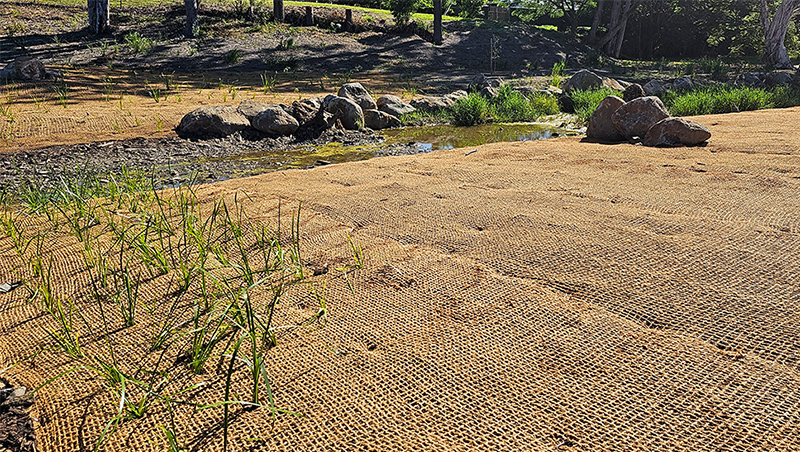
700gsm EnviroBlanket product used in Walshpool Creek Park.
Stabilising Riverbanks
Riverbanks are especially vulnerable to erosion and sediment movement. EnviroBlanket Coir Geotextile Mesh offers a biodegradable, natural solution that stabilises the soil while allowing water to flow freely. As the coir gradually breaks down, it supports vegetation growth, resulting in long-lasting stabilisation and improved ecological balance.
Best Practices for Installing Coir Mesh
-
Site Evaluation: Identify high-risk areas such as steep slopes, channels and concentrated flow paths.
-
Installation: Install coir mesh in configurations such as slope stabilisation mats or check dams. Align mesh with natural drainage patterns for maximum sediment interception.
-
Incorporate Vegetation: Plant native species through the mesh. Vegetation roots help reinforce the material and provide additional erosion protection.
-
Constant Monitoring: Conduct inspections after rainfall events and re-secure areas where the mesh has shifted. Remove debris and ensure healthy vegetation growth.
-
Customisable Solutions: Coir mesh sheets can be cut, overlapped and shaped to suit site-specific contours, providing a flexible and reliable solution for erosion control.
The Importance of Coir Geotextile Mesh in Sustainable Construction
Incorporating Form Direct EnviroBlanket Coir Geotextile Mesh into sediment control plans offers an environmentally responsible approach to erosion management.
Its natural filtration ability, vegetation support and biodegradable lifecycle make it a valuable tool for long-term environmental protection. These qualities help construction and land development projects reduce their ecological impact while meeting regulatory requirements.
Form Direct supplies a full range of high-quality coir mesh products designed for Australian conditions, offering durability, versatility and ease of installation.

