
You have no items in your shopping cart.
Pitfalls of Traditional Bitumen Joint Fillers
For decades, bitumen-impregnated fibreboard was the default choice for expansion joints, and on the surface, it’s easy to understand why. It was cheap, widely available, and familiar to most trades.
But familiarity isn’t the same as performance. Bitumen board is rigid, which makes it difficult to install cleanly around complex geometries like curved kerbs, stepped footings, or irregular slab edges. More critically, it degrades over time. As the bitumen breaks down, the board loses its compressive recovery, allowing soil, moisture, and debris to bypass the joint entirely. What starts as a minor installation compromise becomes a long-term moisture ingress problem, one that rarely surfaces until remediation costs are already high.
For high-stakes civil and commercial projects, these are risks that modern materials have made entirely avoidable.
Selecting the Best Modern Expansion Joint Filler for Your Project
Modern expansion joint fillers like Abelflex and FoamJoint offer a superior alternative. Both products are designed to accommodate the natural expansion and contraction of concrete while providing a reliable moisture seal and easy installation process.
1. Abelflex: The Industry Standard for Versatility
Abelflex is a flexible, closed-cell, cross-linked polyethylene foam expansion joint filler trusted across residential and light commercial construction. Its reputation is built on consistency; it does exactly what it promises, every time, across a wide range of standard applications.
Unlike bitumen board, Abelflex compresses under load and reliably recovers its original dimensions, maintaining a tight seal against soil and moisture ingress throughout the life of the joint. It is exceptionally lightweight, easy to cut on-site without specialist tools, and compatible with most liquid sealants as a back-up filler and bond breaker.
Available in rolls, typically 10mm thick in a recognisable dark grey foam, it suits standard expansion joints in driveways, footpaths, footings, and brickwork. Where your project requirements are straightforward, Abelflex is a proven, cost-effective choice that won’t slow your crew down.
Its limitation is its simplicity. For vertical applications, complex geometries, or builds requiring a clean sealant void post-pour, you’ll quickly find yourself working around what Abelflex wasn’t designed to do, which is where FoamJoint’s specialised variants become relevant.
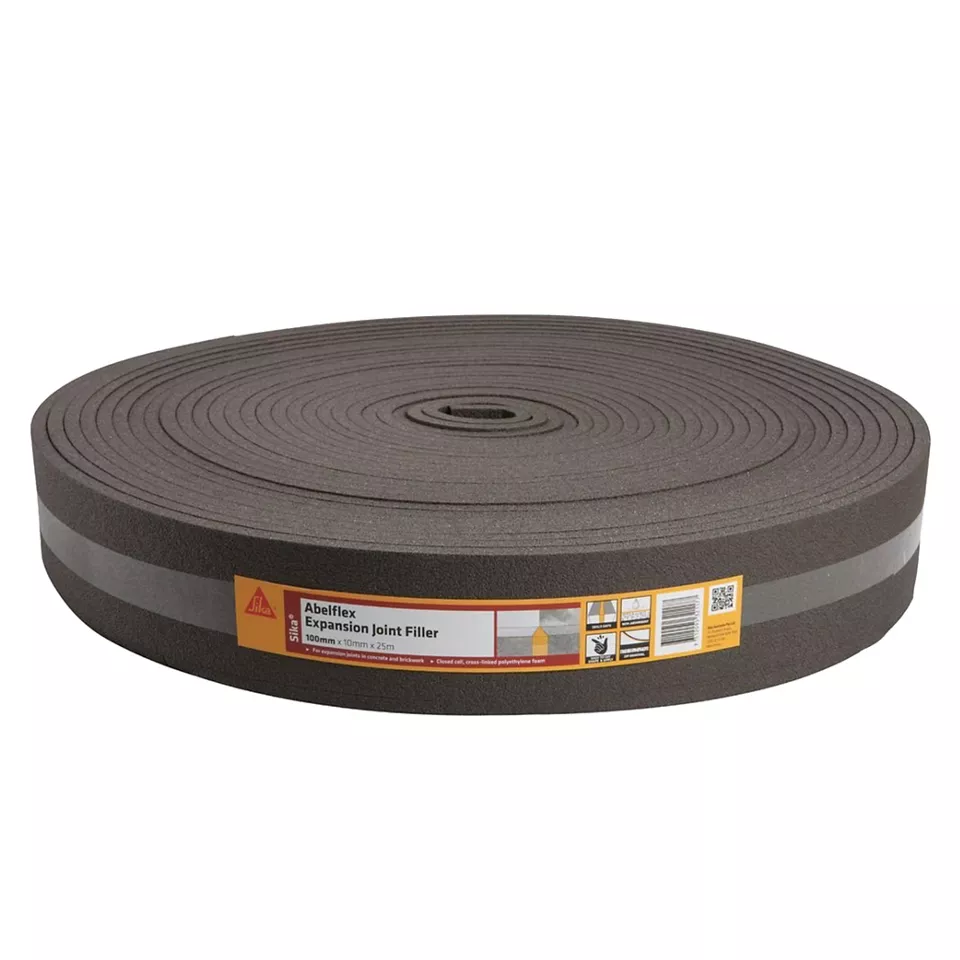
Abelflex is supplied in lightweight rolls, making it fast and easy to cut and install on standard expansion joints.
2. FoamJoint: Purpose-Built Versatility for Complex Builds
FoamJoint is a professional-grade closed-cell polyethylene foam expansion joint filler designed for projects where a one-size-fits-all product simply won’t cut it. Where Abelflex excels at straightforward applications, FoamJoint earns its place on more demanding builds — vertical placements, complex geometries, and pours that require a clean, ready-to-seal void without additional labour.
What sets FoamJoint apart is its range of purpose-built variants, each engineered to solve a specific on-site problem rather than leaving the tradesperson to improvise.
The Zipped Strip variant features a built-in 10mm rip-off strip that can be removed after the pour, leaving a perfectly clean, consistent void ready for sealant — no cutting, no mess, no inconsistent depths.
The adhesive-backed variant solves one of the most frustrating challenges in joint work: keeping the filler exactly where you placed it. Its self-adhesive face holds firm during formwork and pours, making it the go-to choice for vertical, overhead, and tight-access applications. Used alongside builders’ film, it forms a complete moisture barrier system without additional fixings.
For below-slab plumbing and pipework, the Pipe Lagging variant wraps around plumbing and sewerage pipes before the slab is poured, protecting them from concrete pressure while also reducing noise transmission from pumps and air conditioning ducting.
FoamJoint is available through specialist suppliers, including Form Direct, and is the stronger choice wherever your project demands more than a standard joint filler can deliver.
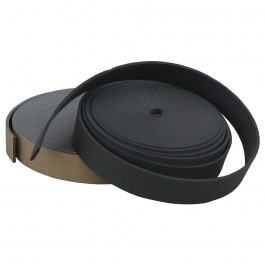
FoamJoint variants — Zipped Strip, adhesive-backed and Pipe Lagging — each engineered for a specific on-site challenge.
Comparing the Two: Which to Choose?
While both products perform exceptionally well as closed-cell PE foam fillers, significantly outperforming traditional bitumen board in moisture resistance and flexibility, your choice depends on the specific project demands. Always ensure your joint filler is used correctly to prevent moisture bypass and allow for natural concrete expansion.
| Feature | Abelflex | FoamJoint |
|---|---|---|
Best For |
Residential & light commercial joints, void filling, and bond breaking |
Complex civil builds, vertical placements, and specific pipe protection |
Material |
Closed-cell, cross-linked PE foam |
Non-absorbent, closed-cell PE foam |
Moisture & Dirt Barrier |
Excellent recovery; reliable barrier against dirt and soil ingress |
Excellent; works flawlessly alongside builders’ film for complete system integrity |
Special Features |
A broad-use industry staple for most standard applications |
Tailored options available: Zipped Strip, Adhesive Backed, and Pipe Lagging |
Installation |
Lightweight, easy to cut and handle on-site |
Adhesive-backed and zipped options significantly reduce labour time and mess |
Availability |
Widely available across most retail and trade outlets |
Professional-grade alternative sourced from specialist suppliers like Form Direct |

